Grinding wheel structure, markings and speed at a glance
A grinding wheel structure diagram explains what is inside the wheel: abrasive grains remove metal, the bond retains them, and pores provide space for chips. Reinforced resin discs also use glass cloth. Below, connect that structure to the grit, grade, dimensions and speed information printed on the label.
View the structure diagram · Decode wheel markings · Check RPM calculations
This guide provides a detailed overview of the core components, working mechanism, and standard marking system of grinding wheels, with a specific focus on products manufactured by FUJI Grinding Wheel Japan. It is designed to help professionals select, use, and verify grinding wheels correctly to ensure both safety and efficiency in their operations.
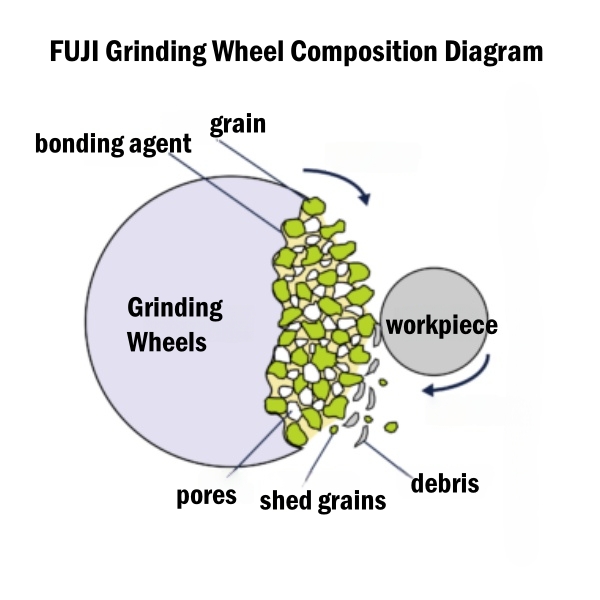
A bonded grinding wheel combines abrasive grains, a bond and pores. Reinforced resin grinding and cutting discs also contain reinforcing material. This guide focuses on these portable-tool discs; not every wheel uses glass cloth or the same internal construction.

Abrasive grains, the cutting edges of the wheel, naturally wear down and become dull over time. As this happens, the bonding agent allows these worn grains to chip away or fall off, exposing fresh cutting edges. Grain fracture and controlled grain release both contribute. This self-renewing process is known as the Self-Sharpening Action. It is the fundamental principle that supports cutting performance when the wheel grade, workpiece and operating conditions are matched. A wheel that retains dull grains too strongly can glaze; one that releases grains too readily can wear quickly.
Grinding wheels are highly specialized tools with countless variations to match different machines, applications, and materials. Wheel markings describe dimensions, abrasive, grit, grade, bond and operating limits. Common conventions are useful, but manufacturer-specific suffixes must be checked against the relevant product documentation.
Example Marking: 125x2.5x22 A30S BF2, Max. Speed 80m/s
Read this example as 125mm diameter, 2.5mm thickness and 22mm bore; A abrasive, 30 grit and S grade; a reinforced resinoid bond designation; and an 80m/s speed limit. It is a label-reading example, not a universal specification. Confirm whether the actual disc is for cutting or grinding; thickness alone does not authorize either operation.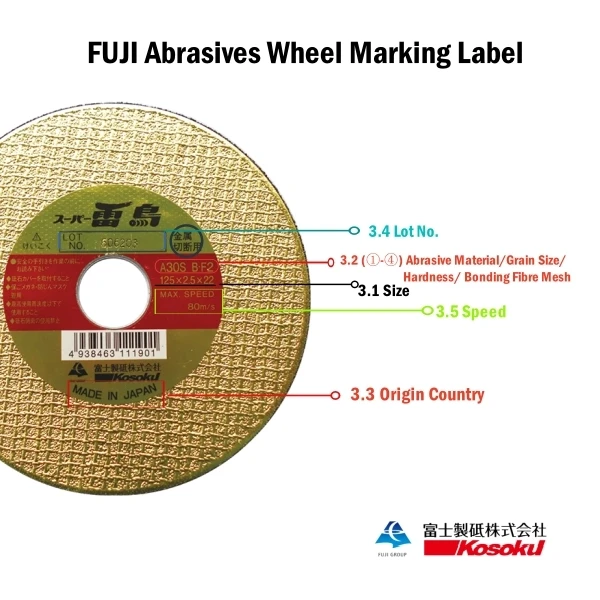
| Marking | Meaning | What to check |
|---|---|---|
| 125 × 2.5 × 22 | Diameter × thickness × bore, in mm | Exact machine and flange fit |
| A / 30 / S | Abrasive / grit / grade | Material, removal and finish requirements |
| BF and suffix | Reinforced resin bond and product-specific code | Manufacturer marking key |
| m/s and RPM | Maximum operating speed | Actual wheel rating and machine speed |
| Type and pictograms | Wheel shape and permitted use | Grinding versus cutting restrictions |
FUJI marks wheel sizes in the strict order: Outer Diameter (mm) × Thickness (mm) × Hole Diameter (mm).
This section of the marking defines the wheel's cutting composition and characteristics.
① Abrasive Material: A commonly denotes aluminum oxide, WA white aluminum oxide, and C silicon carbide. Other letters and blends may be manufacturer-specific. Select the complete formulation for the workpiece, not the abrasive code alone. For example, a wheel containing aluminum oxide is not automatically an aluminum-specific grinding wheel. Confirm stainless-steel or non-ferrous suitability on the product label.
② Grain Size: Refers to the size of the individual abrasive particles.
③ Hardness (Bond Strength): Indicates how strongly the bond holds the abrasive grains. Represented by a letter; closer to 'A' is softer, closer to 'Z' is harder.
A softer grade releases grains more readily; a harder grade retains them more strongly. This is grain retention by the bond, not the hardness of the abrasive mineral. A softer grade can help on hard materials, but contact area, machine power, pressure and finish requirements also matter. Harder is not automatically better.
36P vs 24S: 36 and 24 identify grit size; 24 is coarser. P and S identify grade; S is harder than P within the applicable grading system. For selected FUJI Super F2 specifications, 36P offers a different balance of grain release and grinding feel, while 24S combines coarser grit with stronger grain retention. Confirm availability for the required size through the Super F2 grinding wheel specifications.
④ Bonding Fiber Mesh (BF): Designates the type of bond and reinforcement.
FUJI grinding wheels are produced in two locations, clearly marked on the label:
Where FUJI documentation specifies a YYMM lot-date format, read the first four digits as follows:
Check the actual validity marking: Follow the expiry date, storage conditions and instructions supplied for the product. Do not apply a blanket three-year rule to every wheel or infer remaining life from an unconfirmed lot format. If the marking is unclear, ask FUJI before use.
Never exceed the maximum operating speed marked on the wheel. Exceeding the Maximum Operating Peripheral Speed is extremely dangerous and risks catastrophic wheel failure.
Check the grinder's nameplate and manual for its rated/no-load speed and permitted accessories. A wheel must accommodate the speed the machine can reach in the approved configuration; reduced speed while grinding is not the compatibility reference. The following formulas explain the relationship between diameter, RPM and peripheral speed:
Formula to Calculate Peripheral Speed (m/s):
Peripheral Speed (m/s) = [Wheel Outer Diameter (mm) × π (3.14) × Machine Speed (RPM)] ÷ 60,000
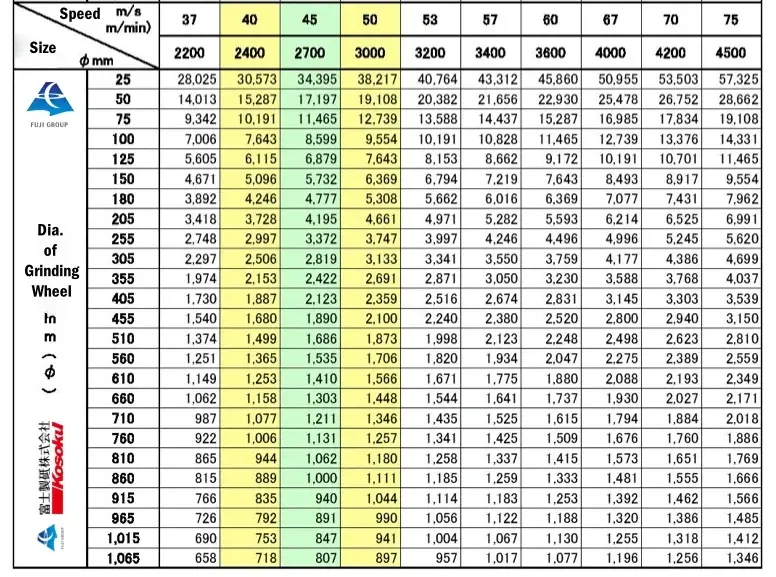
The original reference image uses rounded speed headings and m/min values. Use the calculation below for the stated m/s values; neither chart overrides the product rating.
The table below gives mathematical equivalents, rounded to the nearest RPM. It is not a product approval table and does not replace the wheel's marked maximum RPM.
*Formula: Machine Speed (RPM) = [ (Peripheral Speed (m/s) × 60) ÷ (Wheel Outer Diameter (mm) × π) ] × 1000
| Outer Diameter (mm) | Calculated RPM @ 60 m/s | Calculated RPM @ 72 m/s | Calculated RPM @ 80 m/s |
|---|---|---|---|
| 50 | 22,918 | 27,502 | 30,558 |
| 58 | 19,757 | 23,709 | 26,343 |
| 100 | 11,459 | 13,751 | 15,279 |
| 105 | 10,913 | 13,096 | 14,551 |
| 115 | 9,964 | 11,957 | 13,286 |
| 125 | 9,167 | 11,001 | 12,223 |
| 150 | 7,639 | 9,167 | 10,186 |
| 180 | 6,366 | 7,639 | 8,488 |
* Swipe right to view full RPM table on mobile
Example calculation: A 100mm wheel at 12,000 RPM has a peripheral speed of approximately 62.8m/s. The mathematical equivalent of 72m/s at 100mm is approximately 13,751 RPM. This comparison checks speed only: the actual wheel label, machine speed, diameter, bore, mounting flanges, guard and permitted operation must all be compatible.
It shows how abrasive grains, bond and pores are arranged. For reinforced resin discs, glass cloth is also shown. A label diagram explains printed specifications instead; the two diagrams answer different questions.
No. Grit describes abrasive particle size; grade describes how strongly the bond retains the grains. In 36P, 36 is grit and P is grade. Neither identifies the complete product on its own.
BF identifies a reinforced resinoid bond. The meaning of an additional digit must be checked in the manufacturer's product key; BF alone does not mean one reinforcing layer.
Look on the machine nameplate and in its manual for RPM or min⁻¹. Compare the approved machine speed with the wheel's maximum marked RPM before mounting. If either marking is missing or unclear, obtain confirmation before use.
No. Excessive grain retention can cause dull grains to rub rather than cut. Useful life depends on removal rate, wheel wear, heat and the required finish, not hardness alone.
Age, moisture, damage and storage conditions can affect resin wheels. Follow the actual product validity marking and instructions; an apparently unused wheel is not automatically suitable for use.
Technical reference: For additional background on bond codes and marked operating speeds, see Norton abrasive technical and safety information. Product-specific instructions take precedence over a general guide.
Selecting the correct grinding wheel is fundamental to achieving optimal results and maintaining a safe working environment. By understanding the four core components—abrasive grains, bond, pores, and reinforcing material used in reinforced discs—you can appreciate the engineering behind their performance and safety.
Appropriate self-sharpening supports cutting efficiency, while the detailed marking system provides all the information needed to make an informed choice. Always remember to match the abrasive type, grain size, and hardness to your specific workpiece and application. Most importantly, never compromise on safety: strictly adhere to the size limitations of your machine and never exceed the maximum operating speed marked on the wheel.
By following this guide and consulting FUJI's technical resources, you can make a better-informed selection and identify compatibility issues before use. If you still have questions about FUJI grinding wheels, abrasive tools, or technical specifications? Let our experts guide you! FUJI GRINDING WHEEL, Over 70 Years of Japanese Standard Quality Heritage, Your Reliable Japanese Manufacturer and Partner of Abrasives Products.


