EN 12413, ANSI B7.1 and the relevant JIS standards address different aspects of abrasive-wheel safety. A useful comparison starts with the product type, intended operation and applicable standard edition—not a ranking of countries by a single speed multiplier.
This guide focuses on bonded grinding wheels and cutting discs, especially reinforced resin-bonded products used on portable grinders. It explains how to interpret standards, operating-speed markings and test evidence when purchasing abrasives for fabrication, foundries and shipyards. Requirements for fixed grinding machines, flap discs and diamond or CBN tools must be considered separately.
FUJI Grinding Wheel combines abrasive manufacturing experience with product-specific evaluation. Its Super F2 test example below illustrates how a manufacturer's demonstration can support a technical discussion without replacing the wheel's marked operating limits or a complete conformity assessment.
| Standard or family | Main purpose | What the buyer should check |
|---|---|---|
| EN 12413:2019 | Safety requirements for bonded abrasive products. | Whether the exact wheel type, dimensions, intended operation and speed rating are covered by the supplier's declared conformity and supporting tests. |
| ANSI/UAMA B7.1 | Use, care and protection of abrasive wheels. | Applicable edition and requirements for the wheel, mounting, machine, guarding and safe use. |
| JIS R 6242:2023 | General requirements for bonded abrasive products. | The relevant product requirements and any associated product-specific JIS standards. |
| JIS R 6240:2018 / R 6241:2018 | Testing methods / maximum operating speed of grinding wheels. | Which test method and speed provisions apply to the selected product and how results are documented. |
| JIS R 6243:2018 | Static testing and inspection methods for unbalance of grinding and cutting-off wheels. | Applicable inspection criteria; do not substitute a general rotor-balancing grade for wheel-specific requirements. |
| Other abrasive families | EN 13743 addresses coated abrasives; EN 13236 addresses superabrasive products. | Choose the standard appropriate to the actual product rather than applying EN 12413 to every abrasive tool. |
The BSI listing for EN 12413 identifies its bonded-abrasive scope. The UAMA publications directory distinguishes B7.1 from B74.12, which concerns abrasive grain size, and B74.13, which concerns markings. Grain-size specifications should not be presented as burst-strength requirements.
JIS R 6242 provides general requirements, while testing and maximum operating speed are addressed by related standards. Refer to the Japan Standards Association listing for JIS R 6241 and its current catalogue when specifying editions. Compliance with one Japanese standard does not automatically establish conformity with every overseas requirement.
For deliveries to China or South Korea, confirm the current applicable national standards and market requirements for the exact abrasive product with the importer and supplier. Do not infer that a rule applying to grinding machinery also applies to every consumable wheel. A dimensions standard, environmental assessment and product safety standard serve different purposes.
For a given diameter, peripheral speed and RPM are related by v = π × D × n / 60, where v is in metres per second, D is in metres and n is in revolutions per minute. Use this relation to understand a label, not to override the manufacturer's rating.
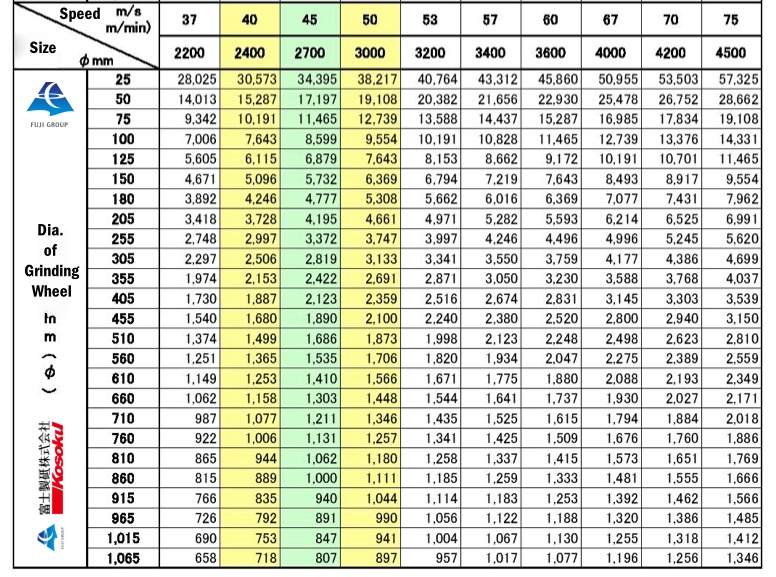
Compare the same wheel category, bond, reinforcement, dimensions, operating speed, intended use and test method before comparing numerical requirements. A speed ratio and a strength-based safety factor are not interchangeable: where a factor is defined through the square of a speed ratio, the numbers have different meanings.
This guide does not assign one universal burst multiplier to every wheel sold in Japan, Europe, China or the United States. A valid numerical comparison needs the applicable standard edition, clause or table, product category and definition of the factor. A higher test result for one sample also does not establish that an entire national system is safer.
FUJI identifies the wheel in this demonstration as a 4-inch Super F2 grinding wheel, 100 × 6mm. FUJI reports that the demonstrated sample remained intact at 30,000 RPM in its controlled rotational test. This is a manufacturer-reported test observation for the demonstrated sample, not a permitted working speed for the product range.


FUJI test video: a controlled test demonstration, not an operating instruction or an independent certification.

To assess the result for procurement, request the sample batch, actual dimensions, marked operating speed, number of samples, test equipment and calibration, acceleration and hold conditions, test method and recorded outcome. The images and video alone do not document all of these details or prove compliance with every clause of a standard.
A standard reference is most useful when it can be linked to the actual wheel being purchased. Check the product label, packaging and supporting information together:
Do not treat a CE certificate as the standard purchasing document for a conventional bonded grinding wheel. The oSa safety FAQ explains why grinding wheels do not bear a CE mark. Requirements applying to the powered machine must be considered separately.
A manufacturer's declaration, a test report, laboratory accreditation and an independently licensed certification mark are different forms of evidence. If a supplier claims a mark or certification, check its validity and product scope. Linking to oSa guidance does not imply that a product is oSa certified or that its manufacturer is a member.
Product strength does not replace correct mounting, guarding and operation. The UAMA grinding wheel safety guide provides practical checks for portable abrasive wheels.
ISO 16089 addresses stationary grinding machines. Its machine requirements should not be copied into a universal portable-disc checklist. Similarly, a generic rotor balance grade is not a substitute for the applicable wheel inspection criteria.
No general ranking is established by the standard names alone. Compare the same product category, applicable clauses and test conditions. A supplier should identify the exact requirements and evidence supporting its claim.
Do not assume it does. EN 12413 addresses bonded abrasive products; EN 13743 and EN 13236 address coated abrasives and superabrasive products respectively. Confirm the applicable scope for the exact product.
No. A controlled test result does not change the marked maximum operating speed. Match the grinder to the wheel's label and follow the manufacturer's instructions.
No. It specifies abrasive grain size. B7.1 addresses the use, care and protection of abrasive wheels; identifying the correct standard is essential when requesting documentation.
Provide the workpiece material, grinder model, dimensions, operating speed, application and destination market. Request a matching specification, traceability information, instructions and relevant test or conformity documentation before confirming the order.
This is a practical purchasing guide, not a replacement for the full standards. The scope references above come from BSI, JSA, UAMA, ISO and oSa. Consult the applicable editions and product-specific documentation for detailed acceptance criteria.
For related product selection, browse FUJI grinding wheels or read our grinding wheel composition and resin disc safety guide.
Send FUJI your wheel dimensions, grinder speed, workpiece material, intended operation and destination market. Our team can help identify a suitable product and discuss the supporting information for that specification.
Contact Our Technical Team


