Can you dress a grinding wheel? The answer depends on the wheel, not simply its bond name. Precision grinding wheels may be designed for dressing or truing. Ordinary fiberglass-reinforced angle-grinder discs require a different approach: do not improvise reshaping or apply a precision-wheel dressing method without explicit manufacturer approval.
This guide explains grinding wheel composition, loading versus glazing, and when to replace a portable disc. For material, grit and product-family selection, use the FUJI grinding wheel selection guide.
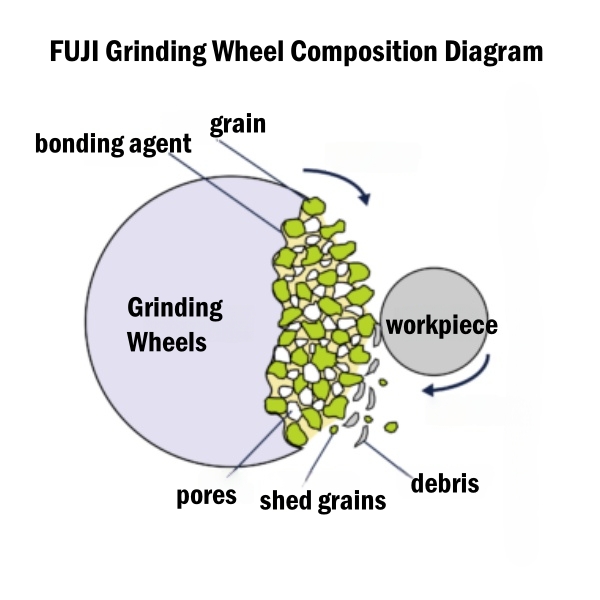
Forming a resin-bonded wheel and curing its resin are separate manufacturing stages. Cold pressing does not mean that a wheel receives no subsequent heat curing. FUJI's warm-press approach should likewise not be confused with the full curing cycle.
Self-sharpening describes grain fracture and grain release during normal grinding. It depends on formulation, material and operating conditions; it does not promise an exact release moment or eliminate all glazing and heat damage. Compare documented performance rather than treating the process name alone as proof of superiority.
The FUJI grinding-wheel wear and metal-removal test illustrates why removal and abrasive consumption should both be reported. Its results are specific to the stated trial.
For example, Norton supplies dressing sticks for certain resin and vitrified CBN wheels and diamond wheels. This is why “never dress any resin-bonded wheel” is too broad.
Dressing conditions the abrasive working surface, such as exposing cutting points or removing loading using an approved method. Truing restores geometry or concentricity. Some processes combine them, while others require separate steps. See Norton's explanation of truing and dressing.
This article's replacement guidance concerns ordinary reinforced discs used on angle grinders, including common 6mm and 7mm grinding discs. Do not improvise dressing with another wheel, a stone or a makeshift tool. Do not grind into the reinforcement or reshape the disc. A procedure intended for a precision diamond wheel is not permission to condition a portable disc in the same way.
If cutting performance deteriorates, stop and identify the cause. Replace damaged, out-of-limit or unsuitable discs and confirm the appropriate specification with the supplier. Any exception requires explicit instructions for that exact product.

Workpiece material can adhere to or accumulate in the wheel surface. This is especially relevant to some non-ferrous alloys. Check the actual alloy and use a product approved for it; selecting a steel disc simply because it fits the grinder is insufficient.
A glazed surface can occur when dull grains remain rather than fracture or release effectively. Wheel grade, abrasive formulation and operating conditions can contribute. Do not assume that adding pressure will solve the problem; review the wheel and task together.
Stop and isolate the tool if there is abnormal vibration, visible damage or uncertainty about mounting. Reject a disc with cracks, chips, damaged reinforcement or other damage under the manufacturer's criteria. Follow the marked expiry and usable-size limits where applicable; never transfer a worn disc to an incompatible smaller grinder.
Poor removal without visible damage still calls for diagnosis. Check material suitability, wheel specification, tool condition and technique before trialling another approved product. A new disc of the same unsuitable specification may repeat the problem.
For stainless steel, evaluate an appropriate FUJI Super W specification. Confirm the alloy and any contamination limits; neither a grain name nor a product family guarantees a burn-free finish.
For compatible heavy metalworking, evaluate the FUJI Super F-2 180mm grinding disc. Compare accepted output and wheel consumption under the same task conditions. Use the material and wheel-type selection table to shortlist alternatives.

It depends on the wheel construction and approved application. Some precision resin-bonded diamond or CBN wheels have specified dressing procedures. Do not apply those procedures to ordinary reinforced angle-grinder discs without explicit manufacturer approval.
For the ordinary reinforced portable grinding discs discussed here, do not improvise dressing, reshape the disc or grind into its reinforcement. Stop using a damaged or unsuitable disc and follow the manufacturer instructions for replacement.
Loading is workpiece material accumulating in the abrasive surface. Glazing describes dull abrasive grains remaining at the surface and rubbing instead of cutting effectively. Both can reduce removal, but they require different diagnosis.
Dressing restores the working condition of an abrasive surface. Truing restores wheel geometry or concentricity. The required procedure depends on the exact wheel and machine; these terms are not interchangeable instructions for portable discs.
No. Self-sharpening describes grain fracture or release during normal use. It does not prevent every instance of loading or glazing and does not remove the need for inspection, correct storage or replacement.
No. Ring testing has a defined application for suitable wheel types and is not a universal integrity test for reinforced resin discs. Follow the inspection procedure specified for the exact wheel and reject damaged products.
Explore more selection, safety and application resources in the FUJI Technical Guides library.
Send FUJI the wheel label, grinder model, workpiece alloy and photographs of the symptom. We can discuss a suitable specification and a practical comparison trial.
Contact Our Technical Team


