The best steel grinding wheel is the one that meets the required removal rate, finish and machine compatibility at an acceptable cost per completed job. General weld grinding, heavy casting cleanup and thin stainless-steel finishing need different combinations of abrasive, grit, bond grade and wheel shape.
This guide compares FUJI options for portable angle grinders and explains how to choose by task. It focuses on reinforced resin grinding discs and related finishing abrasives, rather than precision bench or surface-grinding wheels.
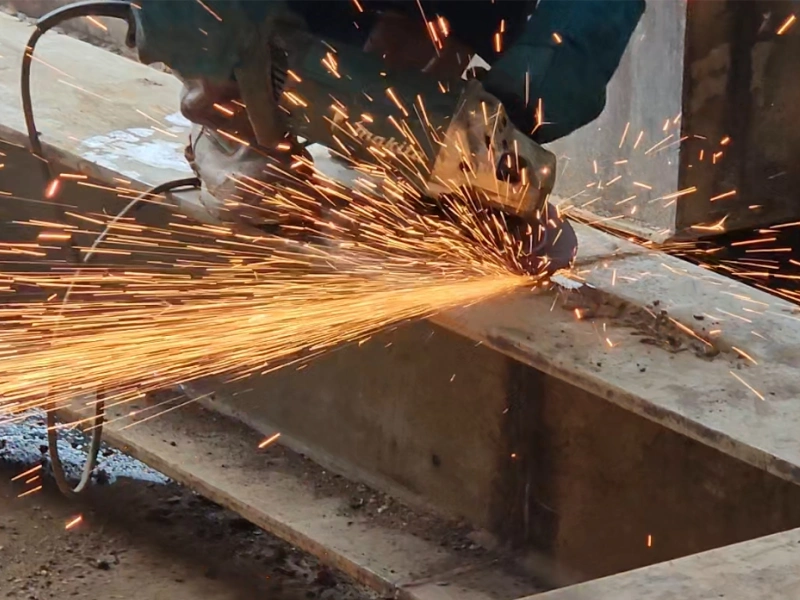 Steel grinding requires a suitable wheel, controlled technique and a compatible guarded tool.
| Task | FUJI starting point | What to confirm |
|---|---|---|
| General carbon-steel weld grinding and deburring | Super F2 | Removal demand, grade, diameter and grinder rating |
| Heavy casting cleanup and demanding stock removal | Super Z zirconia series | Material suitability, contact area and available machine power |
| Stainless-steel fabrication | Super W; assess Green Star or JITAN for the required handling and finish | Alloy, thickness, heat control and contamination requirements |
| Contours and applications benefiting from a semi-flexible wheel | Green Star | Approved material, backing requirements and working angle |
| Compact grinding with a premium zirconia formulation | JITAN 105mm or 125mm | Thickness, access, finish and compatible machine |
| Weld blending and surface refinement | Flap disc | Grit and finish; do not select only by removal speed |
These are starting points, not universal approvals. Check the exact product specification. Aluminum requires an appropriate non-loading formulation; an aluminum-oxide abrasive wheel is not automatically suitable for grinding aluminum.
Super F2 is FUJI's practical, economical series for general steel grinding, weld cleanup and deburring. Selected aluminum-oxide abrasives and a resin bond provide a range of options for everyday fabrication. Choose the formulation and grade for the particular workpiece rather than treating every size as identical.
For demanding steel or casting operations, assess Super Z alongside the machine's power and the amount of material to remove. A more aggressive abrasive is useful when it improves completed-job output without compromising control or the required profile. Validate the combination on representative parts.
Green Star provides a semi-flexible option for suitable metalworking and contour-blending tasks. Wheel flexibility and surface design can help the operator control contact, but they do not guarantee that a thin workpiece cannot burn or distort.
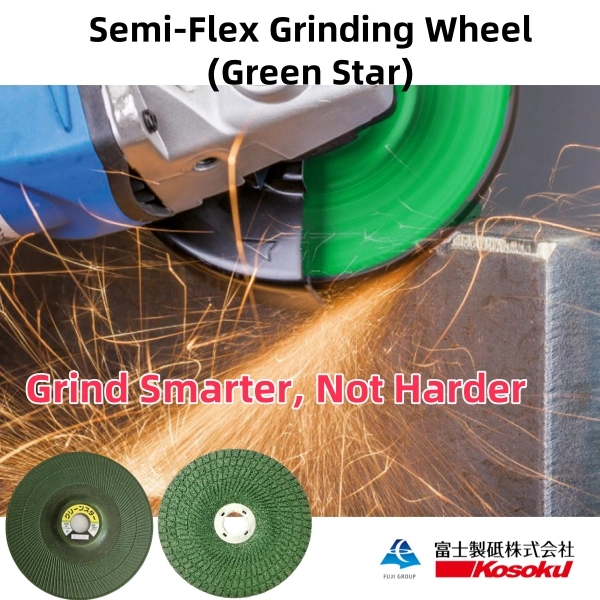
Confirm the available material formulation, dimensions, working angle and any support requirements. On stainless steel, evaluate heat tint, surface quality and handling with the actual alloy and thickness.
JITAN, meaning “time saving,” is FUJI's premium Japan-made zirconia-based grinding series. Its laminated construction and selected resin formulation are designed to support efficient grinding with a controlled grinding feel. The compact 105mm and 125mm sizes are useful where access and handling matter.
Choose from the available 3mm, 4mm and 6mm thicknesses according to the job. A 3mm version can be considered for suitable thin stainless-steel work; a 6mm version suits general removal where greater wear allowance is useful. Neither choice eliminates the need to control pressure, heat and working angle. See also the FUJI zirconia abrasive product overview.
For an economical stainless-specific wheel, review Super W grinding wheels. For subsequent blending and surface refinement, consider a suitable FUJI flap disc rather than expecting a stock-removal wheel to deliver every finishing stage.
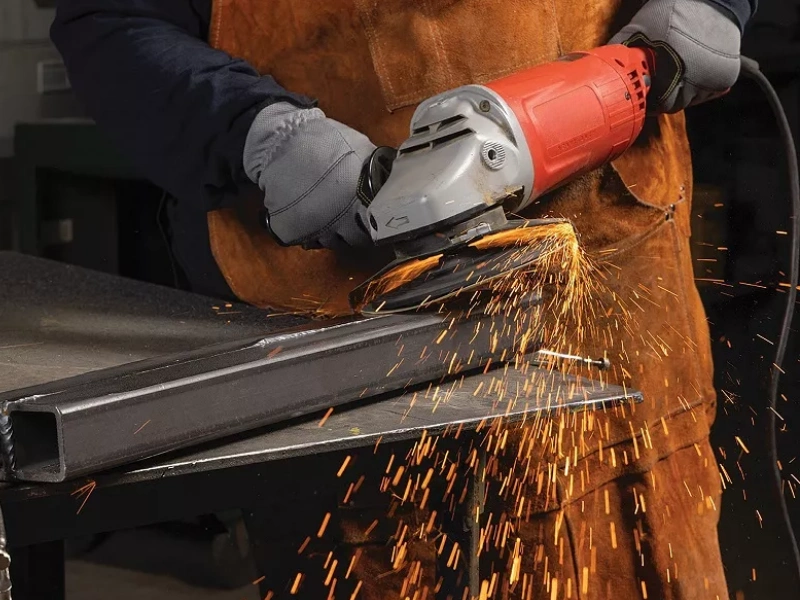
Use the grinding wheel structure and marking guide to interpret label information. Match the marked maximum RPM to the approved machine speed before mounting.
Controlled warmth during forming helps the selected resin and abrasive mixture distribute and consolidate. Forming and the subsequent curing schedule are distinct production considerations. A useful grinding structure balances grain retention, grain release and porosity; the goal is not to remove every pore.
Pores provide space for chips and influence grinding behavior. Abrasive type, bond formulation, reinforcement, pressing and curing all contribute to performance. Neither the process name nor the country of manufacture alone proves a particular wheel's lifespan or safety margin.
FUJI reports longer life in selected internal comparisons, but a percentage from one test should not be applied to every product. Compare matched sizes, workpieces, machines and test conditions. Read more about FUJI's Hot Press / Warm Press process.
| Symptom | Check first | Practical response |
|---|---|---|
| Slow cutting or glazing | Wheel suitability, grit, grade and operating conditions | Assess a more suitable specification. Do not dress a portable reinforced resin disc unless its manufacturer explicitly permits it. |
| Rapid wheel wear | Pressure, contact angle, workpiece and grain retention | Trial a matched grade or formulation; do not automatically choose the hardest grade. |
| Heat tint or distortion | Contact time, pressure, wheel condition and workpiece thickness | Reduce unnecessary dwell, reassess the wheel and validate the finish on a representative sample. |
| Unusual vibration | Wheel condition, mounting, flanges and machine condition | Stop and isolate the machine before inspection. Do not continue with a damaged or suspect wheel. |
Self-sharpening involves grain fracture and controlled grain release. It does not mean a wheel maintains identical performance until it is completely consumed. Replace discs according to the manufacturer's limits and instructions.
FUJI high-frequency grinders can be paired with different abrasives according to the operation. Consider Super Z for demanding removal, Super F2 for suitable general steel work and flap discs for compatible finishing tasks. JITAN is another option where its size, ratings and application fit; it is not the only permissible series.
Electrical frequency in hertz is not wheel speed in RPM. Check the wheel's diameter, bore, maximum RPM and permitted operation against the exact grinder. Do not assume cold-pressed wheels are inherently incompatible, or that warm pressing permits overspeed. Match a 250Hz or 300Hz tool to its specified electrical supply.
A wheel or tool choice cannot guarantee prevention of HAVS or respiratory disease. Control exposure using the actual task assessment, equipment maintenance, dust control and working time. Avoid treating lower perceived vibration as proof of a safe daily exposure.
JIS, EN 12413 and ANSI B7.1 differ in scope and requirements. Do not rank all products using a single national burst-speed multiplier. ISO 9001 concerns quality management and is not a wheel-specific operating-speed approval. See our grinding wheel safety standards comparison for a product-specific approach.
For steel grinding, record time per accepted part, metal removed, wheel mass loss, finish and any rework. A longer-lasting wheel is not necessarily the most economical if it removes metal too slowly. State the wheel specification, workpiece, grinder and test duration whenever publishing a comparison.
Philippine field example: During FUJI visits to shipyards in Cebu and Manila, Super Tsurugi 105 × 1mm cutting discs were compared with other brands on ship-hull steel plate. FUJI reports approximately 30% faster cutting in that trial. Super F2 was also evaluated for weld cleanup and deburring. The cutting-speed result is specific to the Super Tsurugi trial and is not a claim that Super F2 grinding life increased by 30%. Read the Philippine shipyard visit report.
For a new application, arrange a representative sample trial and evaluate the result against the required finish and production cost. Avoid transferring a cutting result to grinding, or a test on one alloy to every metal.
FUJI specializes in resin-bonded grinding and cutting wheels, combining more than 70 years of experience with control over materials, formulation and production. Its abrasive and power-tool ranges allow customers to discuss the wheel and machine together.
Manufacturing origin varies by product. Check the actual label and product documentation for Japan-made and China-made items, available grades and applicable quality requirements.

Choose a formulation for the material, contact area and target finish rather than relying on a single general-purpose claim.
Review the wheel dimensions, speed and working requirements alongside the grinder and available power.
Confirm the exact specification, origin, batch identification and relevant documents for repeat purchasing.
Discuss samples, order quantities and delivery with FUJI based on the actual workpiece and destination.
Super F2 is an economical starting point for suitable weld grinding and deburring. Assess Super Z for heavier removal, or a flap disc when the goal is blending and finishing. Confirm the exact wheel specification and machine compatibility.
Neither is universally better. 24 is coarser than 36, while S retains grains more strongly than P within the relevant grade system. Select by removal, heat, finish, machine power and contact area.
No. A suitable wheel can support heat control, but pressure, dwell time, sheet thickness and material also determine the result. Trial thin or heat-sensitive workpieces before production.
No. A disc previously used on carbon steel can transfer contamination to stainless steel. Use dedicated abrasives where the specification requires it, even if a product is suitable for both materials when new.
No. Select a compatible wheel by task, diameter, bore, maximum RPM and permitted operation. Motor supply frequency does not establish abrasive compatibility on its own.
Do not apply precision-wheel dressing practices to a portable reinforced resin disc unless the manufacturer specifically permits them. Check suitability and condition, and replace the disc when required.
Send the steel grade, workpiece thickness, task, grinder model and speed, current wheel specification and desired finish. FUJI can help narrow the selection and discuss a representative sample trial.


