In the demanding worlds of metalworking, foundries, shipbuilding, and steel fabrication, high-frequency angle grinders support continuous industrial grinding. Selecting the right equipment means matching the grinder, power supply and abrasive to the actual work.
If your work involves extended grinding, understanding European and Japanese high-frequency systems can help you make an informed investment. This guide compares 250Hz and 300Hz high frequency grinders objectively, explains the requirements for replacing older equipment, and introduces FUJI's Japanese-made 300Hz angle and straight grinders. Frequency alone does not determine which tool is better: application, rated power, wheel capacity and system compatibility all matter.
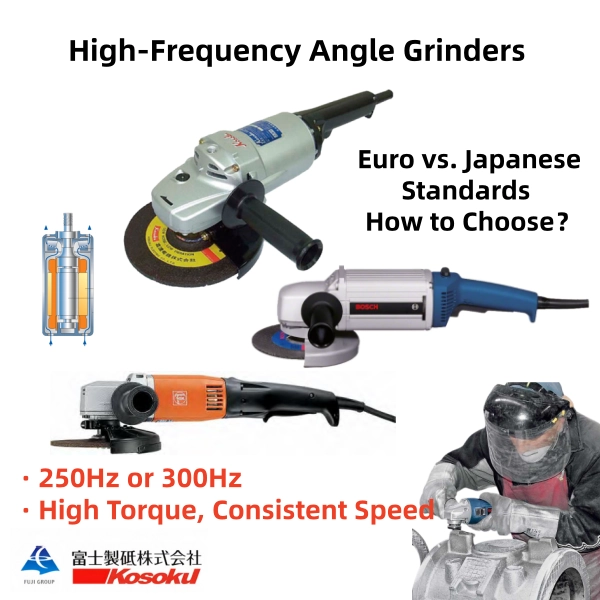
Unlike conventional electric angle grinders connected directly to ordinary 50/60Hz mains, high-frequency grinders use a dedicated high-frequency power supply. Depending on the equipment, systems may operate at 200Hz, 240/250Hz, 300Hz or 400Hz. The converter or generator must supply the voltage, frequency and phase arrangement specified for the tool.
Higher electrical frequency supports the design of industrial induction motors, but it is not the same as wheel RPM. Motor design, pole count and gearing determine spindle speed. A 300Hz grinder is therefore not automatically faster or more powerful than a 250Hz grinder.

For occasional work or locations without a suitable high-frequency supply, a conventional angle grinder may be easier to deploy. For an established foundry grinding line, a compatible high-frequency tool can make use of the existing infrastructure. Compare total installation cost, continuous operating requirements, maintenance support and operator handling before choosing.
The comparison below concerns common system configurations, not a universal European or Japanese frequency standard. European equipment includes different rated frequencies, while Japanese FUJI equipment includes 240/250Hz systems and dedicated 300Hz options. Always use the specific tool and power-supply ratings.
Key Characteristics: Many European foundries already operate 300Hz high-frequency power supplies serving FEIN or Bosch tools. A three-phase 200V/300Hz output is relevant to FUJI's current replacement range, but the converter input, output capacity and connections must be checked on the installed equipment. Fixed workshop systems and other supply arrangements should be assessed individually.
Older grinders differ in wheel diameter, power, speed and weight. A 180mm tool and a 230mm tool should not be treated as equivalent simply because both use 300Hz. Compare the exact models and distinguish electrical input power from mechanical output power.
When an older FEIN or Bosch model has been discontinued or is becoming difficult to replace, customers need another tool option without necessarily replacing the entire power installation. FUJI has developed Japanese-made 300Hz angle and straight grinders for compatible existing European high-frequency supplies. Availability and replacement suitability should be assessed for the specific legacy model, rather than assuming every FEIN or Bosch high-frequency product has been discontinued.
Key Characteristics: FUJI's Japanese high-frequency range includes 240/250Hz tools and matching generators. These provide an additional system choice for users whose power infrastructure and applications suit that configuration. A matched grinder-and-generator combination can be considered for a new installation.
Neither 250Hz nor 300Hz is inherently superior. Weight, handling, duty requirements and maintenance depend on the selected equipment. For a European customer with an existing 300Hz installation, a compatible 300Hz replacement may be the more practical route; a new installation should be evaluated as a complete system.
| Parameter | Existing 300Hz System | 240/250Hz System |
|---|---|---|
| Operating frequency | Use tools rated for the installed 300Hz output | Use tools rated for the specified 240/250Hz output |
| Supply requirements | Check output voltage, phase, current capacity and protection | Check the selected generator and tool specifications as a set |
| FUJI options | HGC-3902 angle grinder; HIC-3802 straight grinder | Matching FUJI grinders and high-frequency generators |
| Wheel or accessory capacity | HGC-3902: 180mm; HIC-3802: 6mm or 8mm collet options | Depends on the selected tool and its approved accessories |
| Power and handling | Compare the exact model, rated power, RPM and weight | Compare the exact model, rated power, RPM and weight |
| Mobility | Depends on supply location, cable arrangement and work area | Depends on generator configuration and cable arrangement |
| Selection priority | Retain suitable infrastructure when replacing old equipment | Evaluate a matched system for the intended work |
FUJI now offers two dedicated 300Hz choices for customers updating industrial grinding equipment. They are designed to connect to compatible existing European high-frequency supplies, expanding the options for replacing aging or discontinued FEIN or Bosch models.
| Model | Frequency / Power | Tool Configuration | Selection Focus |
|---|---|---|---|
| HGC-3902 | 300Hz / 2600W | 7-inch (180mm) high-frequency angle grinder | Accessible casting surfaces, burr removal and industrial surface grinding |
| HIC-3802 | 300Hz / 1600W | High-frequency straight grinder; 6mm or 8mm collet options | Internal surfaces and areas requiring straight-grinder access; confirm the approved mounted abrasive |
The listed power figures are FUJI's current stated ratings. When comparing legacy equipment, verify whether each quoted figure is input or output power. For HIC-3802, select the collet to match the accessory's actual shank diameter; 6mm and 8mm are different configurations, not interchangeable fits.
Choose a high-frequency grinder by starting with the installation and workpiece. Existing 300Hz users and buyers creating a new grinding station face different decisions.
FUJI's 300Hz development gives European users more Japanese-made replacement choices. Send your existing power-supply and tool details to request a replacement assessment. Compatibility should be confirmed before connection; a 300Hz label alone is insufficient.
For a meaningful comparison, use the same workpiece material and comparable approved abrasives, and record removal rate, abrasive consumption, time per part, operator feedback and servicing needs. This provides a better purchasing basis than broad claims that one frequency or country of origin always performs better.
FUJI is developing a higher-power 230mm high-frequency angle grinder to expand its choices for heavy industrial grinding. Development and testing are expected to be completed in 2027, with market introduction planned for that year. Final power, specifications and availability will be announced after testing. Customers requiring a 230mm machine can contact FUJI to discuss their application and receive development updates.
Regardless of frequency or origin, use each grinder within the manufacturer's approved operating conditions.
Frequency alone cannot establish equal performance or superiority. Compare each model's rated power, torque characteristics, spindle speed, wheel capacity and approved operating conditions. Choose the tool that matches your work and power system.
The HGC-3902 and HIC-3802 were developed to provide replacement options on compatible existing European 300Hz supplies. Send the old tool and supply nameplates and connector details so FUJI can confirm the appropriate configuration before ordering and connection.
Weight depends on the exact motor, housing, wheel capacity and tool design. Compare equivalent models and include handling and reach in an application trial; frequency or national origin alone does not determine ergonomics.
Contact FUJI or an authorized distributor to confirm model availability, supply requirements, spare parts and service arrangements for your country. Refer to the published warranty and maintenance policy and the terms supplied with your quotation.
Both are Japanese-made 300Hz tools. HGC-3902 is a 2600W angle grinder for 180mm wheels; HIC-3802 is a 1600W straight grinder with 6mm or 8mm collet options. Select according to the operation, access and approved abrasive.
They need a compatible high-frequency power supply, such as an approved generator or converter. An existing compatible installation may be retained after checking its complete specifications and connections.
Not on wheel size alone. Evaluate the actual process, removal requirements and approved accessories. FUJI's higher-power 230mm model remains under development, with completion of testing and market introduction planned for 2027.
Provide the old grinder and supply nameplates, connector photographs, application, abrasive requirements and quantity. For HIC-3802, specify the required 6mm or 8mm collet. These details help FUJI recommend a suitable configuration.

250Hz and 300Hz systems both have a place in industrial grinding. The right choice depends on the installed power infrastructure and the required operation. For European users replacing aging or discontinued FEIN or Bosch models, FUJI's Japanese-made HGC-3902 and HIC-3802 300Hz grinders expand the available options while allowing a compatible existing high-frequency supply to remain in service.
By weighing casting size, access, abrasive requirements and power-supply specifications, you can select the appropriate tool and plan a practical equipment update. For a new installation, compare the full tool-and-generator system rather than choosing by frequency alone.
Request a compatibility assessment or quotation: Send your nameplate photographs, application and required quantities.
Contact Technical Team for a Quote


